Blog Archive

Crossing the Blues

Showing posts with label German. Show all posts

Mercedes SLR Stirling Moss Edition and Hakkinen Shooting Commercial in Barcelona


Somebody at Daimler must have been a big fan of recent photos showing the Audi A1 S-line in Barcelona's Raval district.  The company has been working on a new video shoot for the Mercedes-Benz SLR Stirling Moss Edition a few kilometers away from the A1 location, and close to scenes used in a video of the Alfa Romeo Giulietta.

The SLR Stirling Moss Edition was the last version that became the SLR McLaren, and was filed in 2009. Is inspired by the 300 SLR that Stirling Moss took the victory in the Mille Miglia in 1955, along with journalist Denis Jenkinson, ie, which has no windscreen or roof or anything like it.

With a weight of 200 kilos less than the conventional SLR, and a little more power (650 horses on the original 617), accelerates from 0 to 100 in 3.5 seconds and can take the 350 km / h. S'en only 75 produced, which were offered only to customers who already have a SLR to your garage. The price? Well 750.000 .- €. Almost nothing.
via:worldcarfans


MW Z4 GT3 Race Car Official Details Released [Video]


The new Z4 GT race car is quickly becoming our favorite modern BMW racer of the past 10 years.

Designed for private racing teams, the GT3 features aggressive styling, advanced engineering, and a 1,200 kilogram (2,645 pound) curb weight. The latter is due in part to the numerous components (front and rear wings, bonnet, roof, and fenders) constructed from carbon fiber reinforced plastic.

As expected the Z4 GT3 car is powered by a 4.0 litre V8 sourced from the M3 GT2. It’s good for more than 480bhp. Other technologies and developments from the Gt2 have been adapted, as well. Things like engine management, ABS, traction control and the sequential shift transmission have all benefitted from previous race experience.

On top of that BMW has also released all the specifications of this V8 powered coupé. As we suspected it’s essentially the same V8 that powers the M3 GT2 race car with over 480 bhp set low and as far back as possible.
Source:BMW


2010 BMW Z4 GT3 2010 BMW Z4 GT3 2010 BMW Z4 GT3 2010 BMW Z4 GT3 2010 BMW Z4 GT3 2010 BMW Z4 GT3 2010 BMW Z4 GT3


Press Release

Love at first sight: the new BMW Z4 GT3.


Munich, 22nd March 2010. The BMW Z4 GT3, which was officially launched and completed its first test drives at the start of March, is already enjoying great popularity among BMW Motorsport customers. The first cars have been delivered to private BMW teams, who will prepare them for use in various national and international championships.

"The feedback on the BMW Z4 GT3 is extremely positive," says BMW Motorsport Director Mario Theissen. "This sports car rounds off our product range, and offers drivers and teams the opportunity to compete in championships in accordance with the GT3 regulations - such as the FIA GT3 European Championship, the International GT Open or the ADAC GT Masters - as well as at 24-hour endurance races." In addition, the BMW M3 GT2, the BMW 320si WTCC, which complies with Super2000 regulations, and the close-to-production BMW M3 GT4 are also available to customer teams from all over the world at BMW Motorsport Distribution.

The production model of the BMW Z4 is already impressive: with its elongated bonnet, flared wheel arches, long wheel base and narrow projections, the car boasts an unmistakable appearance. The two-seater provided BMW Motorsport engineers with a good basis for developing a close-to-production GT3 racing car.

The largest difference between production and racing car can be found under the bonnet: while the production version of the BMW Z4 is driven by a six-cylinder engine, the GT3 car is powered by a 4.0-litre eight-cylinder engine similar to the unit used in the BMW M3 GT2. This powerful heart produces over 480 bhp. Its excellent performance characteristics and good torque curve make the base engine from the production version of the BMW M3 predestined for use in motorsport.

The fitting of the V8 engine had a considerable influence on the development of the BMW Z4 GT3. Initially, design-space examinations were performed using CATIA V5 design software, in order to place the engine in the ideal position and meet racing specifications. The engineers then added all the other components.

When it comes to electronics, the private teams can look forward to innovative BMW solutions, which have already been tried and tested on the BMW M3 GT2: the modern ECU408 takes over the engine management, while the Power400 electronic control unit is responsible for controlling all the actuators. The power is transmitted through a six-speed, sequential gearbox with "Quick Shift" function.

Rims with central locking and safety clip are also included in delivery. In addition, the BMW Z4 GT3 also offers driver assistance systems such as racing ABS and traction control, which have been adopted from other cars in the customer racing range, and then further developed and modified for use in the GT3 car.

The front axle of the BMW Z4 GT3 is a completely new design, based on a series concept. It is equipped with a tubular stabiliser bar with adjustable blades. The rear axle is designed as a longitudinal link axle, as with the series version of the BMW Z4. The steel body of the car comes from the BMW Plant in Regensburg. A safety cell made of extremely rigid, precision steel tubing is then welded into the body. The engine block of the V8 engine is produced in the BMW foundry in Landshut. The BMW Plant in Dingolfing contributes the rear axle differential and drive shaft, among other things.

During the development, BMW Motorsport engineers worked hand in hand in other areas with their colleagues from series production. This allowed them to access calculations from the field of computational fluid dynamics (CFD) when designing the car's aerodynamics. Furthermore, tests were also carried out in the wind tunnel and on the BMW Group's test benches.

Front and rear wings, bonnet, roof, fender and many other components are made of carbon fibre reinforced plastics (CFRP). Using this lightweight, torsion-resistant material contributed significantly to reducing the weight of the BMW Z4 GT3 to 1,200 kilograms.

As with all cars in the BMW customer racing range, the emphasis was also put on cost-efficiency when developing the BMW Z4 GT3. As a result, the car offers a very good cost/performance ratio and gives private teams the opportunity to participate in affordable motorsport at the highest level.

The BMW Z4 GT3 is available as a racing car at a cost of 298,000 Euros (plus VAT). Interested teams can find further information at: Z4GT3@bmw-motorsport.com.

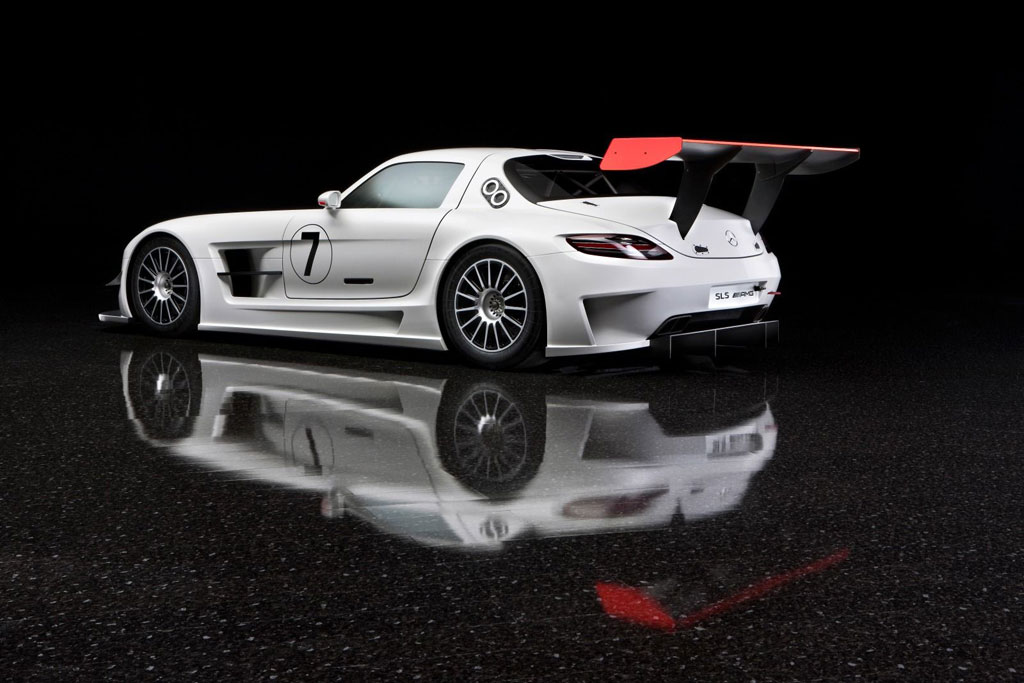
Leaked: Mercedes SLS AMG GT3


Now, a series of leaked pictures showing the Mercedes AMG SLS GT3 racecars have surfaced, showing the car in all its glory.

The car pictured here features a heavily revised body which includes the front bumper with large central intake and lower splitter, canard air foils, hood, fenders with deep wheel well vents, huge side sills, that massive carbon rear wing integrated into the boot lid, fuel filler pocket in the quarter panels and rear bumper with purposeful diffuser.

Inside the car is a true racer with carbon fiber racing seats, a carbon center console and racing digital dash – which even has lights to notify the driver when to shift.

The car will used a modified version of the production V8 engine. This is a 6.2 liter naturally aspirated powerplant that develops 571 hp at 6,800 rpm and 480 lb-ft of torque at 4,750 rpm.

According to the Mercedes-Benz-Passion blog, full details are set to be released on March 27th, with the car set for its racing debut in the Spring of next year.


SLS AMG GT3 SLS AMG GT3 SLS AMG GT3 SLS AMG GT3 SLS AMG GT3 SLS AMG GT3 SLS AMG GT3 SLS AMG GT3 SLS AMG GT3 SLS AMG GT3 SLS AMG GT3 SLS AMG GT3 SLS AMG GT3 SLS AMG GT3 SLS AMG GT3 SLS AMG GT3


Press Release

Mercedes-Benz SLS AMG GT3

Spectacular racing car for the sporting customer

Puebla (Mexico) - Coinciding with the market launch of the SLS AMG on 27
March 2010, Mercedes-AMG is presenting a GT3 variant. This racing version of
the gullwing model stands out with its spectacular design and thoroughbred
motor sports technology. Developed to comply with the GT3 specifications of
the FIA (Fédération Internationale de l'Automobile), the SLS AMG GT3 is
designed as a racing sports car for customers competing in sprints and
long-distance races. These race series for near-series GT cars are noted for
their very varied participants and great excitement. Not least because of
their comparatively favourable cost structure, they are enjoying increasing
worldwide popularity.

AMG, the performance brand within Mercedes-Benz, is entering a new
business sector with the new SLS AMG GT3: the development, production and
marketing of sports racing cars intended for customer use. Sales of these
customer cars are expected to commence in autumn 2010, and homologation of
the GT3 variant will be completed in time for the 2011 racing season.

"Thanks to uncompromising lightweight construction and superior handling
dynamics, the SLS AMG provides an outstanding basis for a highly competitive
racing car. This exciting GT3 version is our response to strong customer
demand for a car designed for these attractive motor sports series. Once
again, it demonstrates AMG's huge experience gained in more than 40 years of
motor sports, and its great expertise in the development of unique
high-performance cars," says Volker Mornhinweg, Chairman of Mercedes-AMG
GmbH.

The new SLS AMG GT3 is an emphatic continuation of AMG's commitment to
motor sports. AMG has been a pioneer in the motor sports world ever since
its foundation in 1967. The new racing version of the SLS AMG is developed
and produced by AMG in close cooperation with HWA AG. HWA is responsible for
the DTM racing team on behalf of Mercedes-Benz Motorsports. The HWA team is
one of the most successful in international motor sports, as witness nine
driver championships in the DTM and ITC, as well as two championship titles
in the FIA GT Championships.

The SLS AMG GT3 is set to write another chapter in this success story,
and harks back to the 300 SL racing sports car of 1952 which first
established the "gullwing" legend. Its historic victory in the "Carrera
Panamericana" long-distance race also made Mercedes-Benz a household name in
North and Central America, and demonstrated the know-how and expertise of
the Stuttgart-based automobile company.

Spectacular racing car looks and top-class performance

The new SLS AMG GT3 is wide, flat and has spectacular racing car looks. The
main focus when modifying the body of this gullwing model was on aerodynamic
performance - as is seen not only in the new front apron with a splitter,
the bonnet with its central cooling air vent and the wider front and rear
wings, but also in the the side wheel arch air vents, the sideskirts with
cooling ducts for the rear brakes, the smooth underbody with a rear diffuser
and the adjustable rear aerofoil. All these features ensure a low drag
coefficient and maximum downforce - while guaranteeing effective cooling of
thermally highly stressed components. The C-pillars accommodate the
standardised filler pipes for the fast-refuel system.

The FIA will determine the maximum output of the AMG 6.3-litre V8
front-mid engine with dry sump lubrication on the "Balance of Performance"
principle. This is intended to ensure that all the racing cars taking part
have an equal chance. The classification process, during which the kerb
weight is also determined, will be completed in 2010. Power transmission in
the GT3 variant is by a sequential six-speed racing transmission with
steering wheel shift paddles and an integrated multi-disc locking
differential. As in the standard SLS AMG, the transmission is located at the
rear axle: the engine and transmission are connected by a torque tube within
which a carbon-fibre shaft rotates at the engine speed, as in the roadgoing
version.

The wheels are located by a double-wishbone suspension of forged
aluminium at the front and rear. Adjustment facilities for the springs and
shock absorbers, the suspension height, the stabilisers, the track width and
camber allow an individual setup for the racetrack. Rack-and-pinion steering
with a more direct ratio and speed-sensitive servo assistance make for
extremely agile handling. Behind the central-locking AMG light-alloy wheels,
a composite steel racing braking system with racing ABS ensures outstanding
deceleration.

Functional racing car atmosphere in the interior

The interior of the SLS AMG GT3 is dominated by a functional racing car
atmosphere: the steel rollover cage not only ensures the driver's safety,
but also adds additional reinforcement to the aluminium spaceframe. Another
eye-catching feature is the racing bucket seat with a six-point seat belt
and HANS system (Head and Neck Support). The central display is perfectly
positioned in the driver's field of vision, and shows all the relevant
information such as speed, engine rpm, operating temperatures, lap times and
the selected gear. The open-top racing steering wheel with gearshift paddles
makes perfect vehicle control possible.

Additional controls are located on the centre console. This is where the
driver can not only start the AMG V8 engine or adjust the traction control,
but also select reverse gear or - if the worst comes to the worst - activate
the integrated fire extinguisher system. The adjustment control for the
brake balance is located on the torque tube tunnel.


VW HAPPY 60TH BIRTHDAY TO THE WORLD'S MOST POPULAR VAN

Volkswagen T5 and T1 Transporter vans

The Volkswagen Transporter was first produced in March 1950, making this month its 60th anniversary. The popular van has subsequently sold over 10 million units worldwide and gone through five generations of evolution. The latest T5 facelift was launched in the fourth quarter of 2009 and comes in styles such as the people-carrying Caravelle as well as the campervan California.

Volkswagen Transporter T2 van 1968

That first model, the T1, featured a four-cylinder, air-cooled, 1.1-litre petrol engine typically fitted at the rear end. It made 18 kW (25 PS / 25 bhp) and could muster a top speed of 97 km/h (60 mph) when really pushed.

Volkswagen Transporter T3 van

In comparison the latest T5 model is powered by a 2.0-litre common rail turbo diesel unit pushing out between 62 kW (83 bhp / 84 PS) and 132 kW (178 bhp / 180 PS), and can run up to 192 km/h (119 mph).


Volkswagen Transporter T1 van 1950

Over the years the Transporter became an icon for both business and leisure use. From rock bands to fleet managers, to families of seven, people bought it for its generous interior space and comfort.

Volkswagen Transporter T4 van
More Photos


Press Release

HAPPY 60TH BIRTHDAY TO THE WORLD'S MOST POPULAR VAN

Production of the Volkswagen Transporter van officially started in March
1950 and during the 60 years since then it has become one of Volkswagen
Commercial Vehicles' best-selling models globally, the number one imported
van in the UK as well as one of the most iconic and popular vans in the
world.

With over 10 million produced, the Volkswagen Transporter has evolved
through five generations of functional and practical bodystyles, each
representing the ultimate multi-purpose vehicle of its time and loved by
business and private users alike for transporting goods or people for work
or leisure. This unique heritage is the focus of the current ‘Evolution of
Van' advertising campaign for the new Transporter which was launched in the
UK in January.

The first T1 ‘split-screen' model was powered by a four-cylinder,
air-cooled, 1.1-litre petrol engine mounted at the back of the vehicle. It
produced 25 PS of power and had a top speed of about 60 mph. By comparison,
the new Transporter enjoys the refinement of Volkswagen's latest 2.0-litre,
common rail, turbocharged diesel engine, available with power outputs
ranging from 84 PS to 180 PS and a top speed of up to 119 mph, plus the
latest stability control systems and braking technology that would have
sounded like something from a science fiction novel 60 years ago.

Although the design has evolved over the years, the first and the latest
Transporter share the same badge on the front and the same design principles
of a generous loadspace and an enviable reputation for quality and
durability.

Similarly, comparing the latest Volkswagen California with a T1 campervan
shows that both make efficient use of the space available to create a
vehicle equally suitable for daily trips to work or the shops, as for
weekend escapes or continental capers.

Over the years, Volkswagen Transporters have endured challenging round
the world trips by enthusiastic travellers, been used as the preferred
choice of travel for rock bands since the 1960s to the present day, and been
relied upon by many businesses needing a fleet of delivery or passenger
carrying vehicles.

The first Transporter was imported into the UK in 1955, and the latest
version of the van as well as today's people-carrying and campervan
versions, the Caravelle and California, arrived in the UK this January, 55
years later.


Porsche Celebrates 60 Years of Production in Stuttgart-Zuffenhausen

Porsche 911 in front of the Plant 2 at Zuffenhausen - 1965

Porsche is celebrating the 60th anniversary of car production in Stuttgart-Zuffenhausen.

Zuffenhausen has been Porsche’s home address since 1938 and more than one million Porsche sports cars have been built in Stuttgart since 1950.

The model 356 Type A in front of the Porsche Plant 2 at Zuffenhausen - 1955

The first Stuttgart built Porsche 356 rolled off the assembly line in April 6th. In 1950 a total 369 cars were produced. In 1952 company opened there a second plant. In 1956 the 10,000th Porsche 356 left the plant. Porsche Plant 3 was opened in 1960, also housing the Sales and Customer Service Departments.

The assembly of the Porsche 356 B -1961

In 1964 Porsche KG(company name at the time) took over the Reutter Coachbuilding and Body Construction Company with its workforce of approximately 1,000 employees, that helped increase the production of the 911 model series.

The 500th Porsche 356 left the plant in spring 1951

To celebrate this milestone, the Porsche museum will host a special exhibit with a series of early production photographs and the first 356 Coupe built in Zuffenhausen. The event runs from March 20th to May 9th.
More Photos


Press Release

Special Exhibition in the Porsche Museum from 20 March to 9 May 2010

Sixty Years of Porsche Production in Stuttgart-Zuffenhausen

Stuttgart. The home of today's Dr. Ing. h.c. F. Porsche AG, Stuttgart,
has a very special sound in the world of motoring: Zuffenhausen. Indeed,
Zuffenhausen is far more than "just" a production plant rich in tradition
for Porsche AG, since it is here in Zuffenhausen that the heart of the
Company beats to this very day. Zuffenhausen has been Porsche's home address
for more than 70 years and more than one million Porsche sports cars have
been built here in Stuttgart since 1950.


The Porsche Design and Construction office moved from Kronenstrasse 24 in
downtown Stuttgart to the new group of buildings in the District of
Zuffenhausen way back in June 1938. Right from the beginning, important
chapters in the history of the automobile were then written in Porsche's
home plant: This is where the first series of the car destined to become the
Volkswagen Beetle was built in 1938, followed in 1939 by the Type 64 as the
great-grandfather of all Porsche sports cars to come in later years.
Originally planned for the Berlin-Rome long-distance race, this aerodynamic,
highly streamlined sports car became the trendsetter for all Porsche models
to follow.

After the first few units of the Porsche 356 had been built in the
Austrian town of Gmünd as of 1948, Porsche returned to Stuttgart as a
genuine "car city" in late 1949. With the Porsche Plant in Zuffenhausen
still being occupied at the time by the US military, Porsche first rented a
production hall on the premises of the nearby Reutter & Co. GmbH
Coachbuilding and Body Construction Plant, starting to prepare production in
early 1950.

With the first Type 356 being completed in Stuttgart on 6 April 1950,
overall production up to the end of the year amounted to 369 units. The
success of Porsche's sports cars is borne out clearly not only by the
Company's sales figures, but also by the further expansion of the production
facilities in Zuffenhausen. The buildings forming Porsche Plant 2 designed
by the well-known architect Rolf Gutbrod were completed in 1952 and in 1956
the 10,000th Porsche 356 left the plant, which was consistently enlarged and
upgraded over the years. Porsche Plant 3 followed in 1960, also housing the
Sales and Customer Service Departments.


Immediately after the introduction of the Porsche 911, Porsche KG, as the
Company was still called at the time, took over the Reutter Coachbuilding
and Body Construction Company in 1964 with its workforce of approximately
1,000 employees. Today the complete 911 model series as well as models of
the Boxster series and all Porsche engines are built in Zuffenhausen.

The Plant is split up into the Bodyshop, Paint shop, Vehicle Assembly,
Upholstery, Engine Assembly and Test Dynamometers. To ensure flexible
production in a confined area, Porsche has developed special solutions
including multi-floor production in the Bodyshop and Vehicle Assembly. A
further special feature is that Porsche's series models are built together
with the racing versions on one and the same assembly line. As yet a further
highlight a new, particularly ecological Paint shop will be opened in 2011.
Currently being built in the direct vicinity of Plants 1 and 5, the new
Paint shop will be situated on the former premises of Dürr AG purchased by
Porsche in spring 2008.

The new Porsche Museum was opened in January 2009 as an additional pledge
to Zuffenhausen. Here, virtually on the Company's home ground, some 80
historical cars and exhibits from the history of the Company are presented
in an exhibition area of 5,600 square metres or 60,200 square feet. As the
most spectacular building project commissioned by Porsche, the Porsche
Museum has not only gone down in the history of the Company, but also
enriches the entire Stuttgart Region as an outstanding highlight in culture
and architecture.

The Porsche Museum is honouring the 60th anniversary of Porsche in
Zuffenhausen with a special exhibition: The beginnings and the ongoing
development of production at Zuffenhausen are being presented by a series of
photos in this exhibition from 20 March to 9 May 2010. A further outstanding
highlight is the first Porsche 356 Coupé built in Zuffenhausen shown for the
first time in the Museum after an unusual restoration process.

The Porsche Museum is opened Tuesdays to Sundays from 9:00 to 18:00. For
further information, see the internet at www.porsche.com/museum.


Cargraphic - Porsche Cayenne Diesel

 Porsche Cayenne Diesel by Cargraphic

Diesel cars are good for consumption, but usually their appearance is left on second place. This is where tuners come along and change it. And this is the case with the Porsche Cayenne Diesel, a good looking car, for sure, but not as good looking as, lets say a Turbo version.

 Porsche Cayenne Diesel by Cargraphic

Consisting of a rear valence and a stainless steel exhaust system, the package (€2,495) evokes the rear-end of the Porsche Cayenne Turbo. Of course, to complete the Diesel to Turbo transformation, you'll also need the front valance and side skirts.

 Porsche Cayenne Diesel by Cargraphic

The Cargraphic upgrade kit for the Porsche Cayenne 3 litre Diesel The Cayenne Diesel is a real alternative to the petrol-driven models, especially for long-distance motoring. Diesel drivers can really get their money's worth...

 Porsche Cayenne Diesel by Cargraphic

And of course the engine’s power was also upgraded: from a standard 240 hp, the tuner raised it to 290 hp and 630 NM of torque.
via:topspeed


Press Release


The Cargraphic upgrade kit for the Porsche Cayenne 3 litre Diesel
The Cayenne Diesel is a real alternative to the petrol-driven models, especially for long-distance motoring. Diesel drivers can really get their money's worth, not just in economic terms, and this is down to the V6 unit's high torque of 550 Nm at 176 kW / 240 PS. The only issue is the look, which does come across as somewhat tame, compared with the top Cayenne models. Yet even this is now no longer a major shortcoming, as Cargraphic, the traditional customizing company from Germany, has now included in its range a conversion kit for Cayenne Turbo look.

What the vehicle enhancement specialists, with their reputation for attention to detail, can offer the customer is a matching rear valence along with sports exhaust, heat shield and end pipes, all for 2,495 euros (plus VAT). The exhaust systems are produced in England by Cargraphic's own manufacturers, working to the highest standards of craftmanship. Only high-grade stainless steel is used, good enough to satisfy even the quality standards demanded in the aviation industry.

All that remains, then, is the "moral" issue of whether a diesel model should actually even be allowed to bear the Turbo insignia. Michael Schnarr, who heads the company along with his brother Thomas, has got the answer: "Technically, the diesel engine used in the Cayenne is actually a turbo engine." And on the subject of performance, he points to another of the company's products. Thanks to an upgrade via software, the engine power soars to 290 PS (213 kW) and the top speed rises to 133 mph (221 km/h). In terms of torque - now up to 630 Nm - the diesel model is now getting dangerously close to the "real" Turbo Cayenne, with its 700 Nm. The price of the software performance upgrade runs to 995 euros (plus VAT).

ENCO Exclusive Audi Q5

 ENCO Exclusive Audi Q5 wallpaper

The Audi Q5 is available on the German market since November 2008. Since that time, was successful with the fans of SUVs and the tuners are adding their own touches to the five-door model. And Enco Exclusive shows probably the most incredible interpretation of the Q5. This is ENCO Exclusive Audi Q5

 ENCO Exclusive Audi Q5 wallpaper

Among the features included in ENCO Exclusive’s Q5 kit includes large blackened air inlets to both sides of the radiator grille, a new hood with a sublime mid-section with two chrome air outlets, a new front spoiler, a rear bumper skirt with exhaust pipes and a rear spoiler. The package is finished by brand new silver monoblock set of 22-inch wheels in Enco "Jura" design.

 ENCO Exclusive Audi Q5 wallpaper

Carbon fiber has been used throughout the interior. Also thrown into the mix are 10x22-inch monoblock wheels wrapped in Pirelli Scorpion Zero tires. Wheels come standard in silver and can be painted if desired.

 ENCO Exclusive Audi Q5 wallpaper

The new chassis kit for the ENCO Exclusive Audi Q5 is based on his older brother or particularly Q7 TDI V12. The price is $ 130,000.

 ENCO Exclusive Audi Q5 wallpaper
More Photos


Press Release

ENCO Exclusive Audi Q5

Quick change artist

The Q5 from Audi has been available on the German market since November
2008. Since then it has extremely successfully cast a spell over the Compact
SUV fans and also vehicle finishers are adding their own mark to the popular
five-door model. Enco Exclusive shows probably the most impressive Q5
interpretation to date.

The newly developed Q5 body kit by the Chemnitz manufacture company is
based optically on its big brother the Q7 or in particular here the V12 TDI.
Therefore anyone who does not want to fork out 130,000 Euros for the top
model or can but still loves the visual appearance of the Super SUV should
directly contact the Enco Exclusive team.

The Saxons' project adds another low dominantly designed front bumper
with the V12 TDI typically large blackened air inlets to the left and right
of the radiator grille into which LED daytime running lights are integrated.
The professionals also installed a new hood with a sublime mid-section with
two chrome air outlets alongside it arranged lengthwise in the driving
direction. On the Q5's sides there are now mudguard and door extensions,
which lend the elegant five-door model a sturdier appearance. The Enco
Audi's rear is dominated in turn by a new skirt, in which the well-known
oval end exhaust pipes from the V12 TDI are integrated, the perfect mix of
optical elegance and sportiness. The finish in terms of updated bodywork is
a body-coloured spoiler above the rear windscreen.

The perfect complement to the whole package is the brand new silver
monoblock set of wheels in Enco "Jura" design with its seven drawn out and
vaulted spokes in imposing 10x22 inch with 285/30 Pirelli Scorpion Zeros
which on request (as in the example of the vehicle shown) can of course be
painted in black or other colours.

Enco Exclusive also updates the interior of the compact SUV on request
with carbon parts which replace the original design elements mounted ex
factory. This and in particular the extensive and stylish body kit turns the
Q5 into a unique eye-catcher and at a clearly more favourable price than is
required for the Q7 V12 TDI top model.

Prices

Complete body kit: 4,165 Euros

  • front spoiler: 1,130 Euros

  • rear bumper skirt with exhaust pipes: 952 Euros

  • muffler right/left: 595 Euros

  • mudguard, door parts: 1,130 Euros

  • rear spoiler: 1,125 Euros

Hood: 1,785 Euros

Assembly/mounting: 1,190 Euros

Painting: 1,488 Euros

Lowering springs incl. installation and measurement: 595 Euros

Set of wheels 10x22 inch silver with 4,641 Euros

285/30R22 incl. adapter tyres:

Extra charge for painting set of wheels: 476 Euros

Carbon interior: 1,428 Euros